
Steel mill lubrication: Why heat, dust and water make grease supply a reliability issue
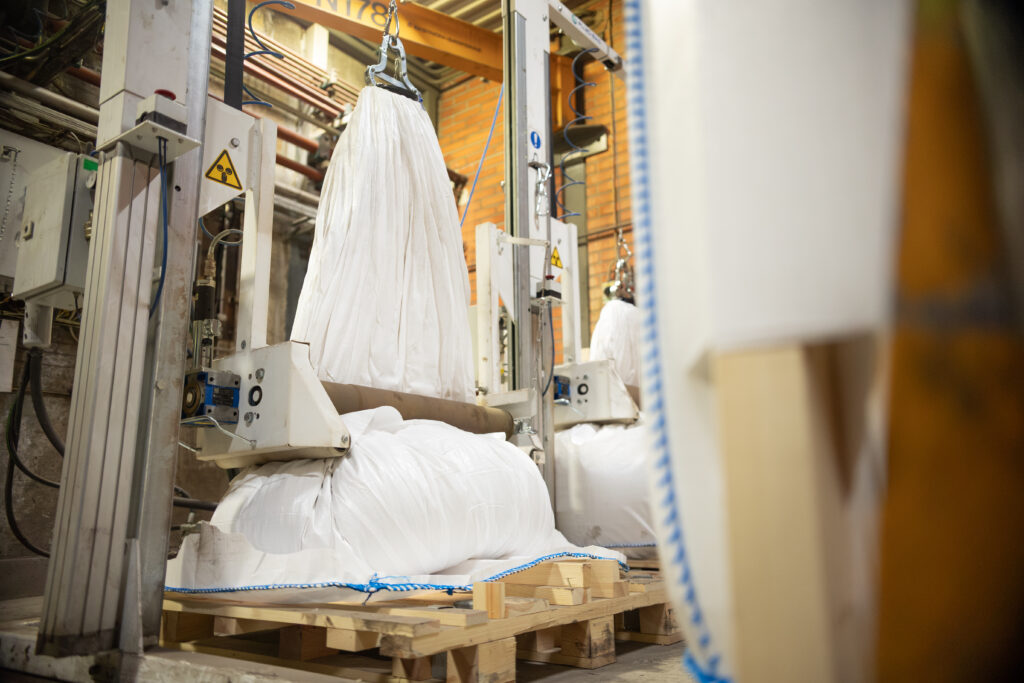
We have supplied grease handling solutions to steel mills for more than two decades. In this article, we walk through the conditions that make steel plant lubrication so unforgiving, show where grease picks up contamination before it reaches the system, and put numbers on what each container change costs.
We then look at how two steel producers – Friedr. Lohmann in Germany and SSAB Raahe in Finland – protected their grease supply.
Key takeaways
- Steel mills combine heat, shock loads, water, scale and continuous operation; every major lubrication stress at once.
- Grease cannot be filtered once it is in a centralized lubrication system. What enters the reservoir reaches the bearing.
- Every container change opens a contamination window. With 200-liter (55 US gal) drums, those windows open five times per 1,000 liters.
- A sealed 1,000-liter (264 US gal) Fluid-Bag replaces five drums and keeps grease closed from the supplier’s filling line to the lube pump.
What makes steel mill lubrication different?
An integrated steel plant tests grease harder than almost any other industrial environment. Trade publication Lubes’N’Greases lists what steel mill greases must withstand: high-speed operation, extreme shock loads, wide temperature ranges, dirt, dust, water ingress and vibration.
And rarely one at a time.
Take a hot strip mill. Bearings close to the hot steel run far above normal temperatures, which shortens grease life. Cooling water and steam surround the same bearings, washing out grease and driving corrosion. Mill scale and metallic dust hang in the air and settle on every exposed surface. And the line keeps running, because a planned stop is expensive and an unplanned one is worse.
The continuous caster adds its own extremes; hundreds of slow, heavily loaded rolls under constant water spray. We cover it separately in the article Continuous caster lubrication: Why the grease supply matters as much as the grease.
How do scale, dust and cooling water reach the grease?
Contamination reaches steel mill grease by two routes: at the bearing, and before the grease ever leaves its container.
At the bearing, the route is well documented. An STLE case study of bearing failures in a bar and rod mill describes steel scale peeling off the rolling stock as highly abrasive, and relies on seals and grease to keep scale and water out of the bearings. Seals, purge cycles and water-resistant greases all exist to fight this route.
The supply route gets far less attention. Grease that sits in an open drum in a dusty hall, or that passes a contaminated pump tube during a changeover, carries particles and moisture into the system before it reaches a single seal.
No bearing seal can stop contamination that arrives inside the grease.
>Why do steel plants use centralized lubrication systems?
A centralized lubrication system meters exact amounts of grease from one pump and reservoir to hundreds of lube points. Steel mills typically run total loss systems – single-line, dual-line or progressive feeder systems, as classified under DIN 24271 – with greases from NLGI 000 to NLGI 3. Hot, remote and hazardous lube points get grease on schedule, without a technician walking a route.
The system has one built-in limit: grease, unlike oil, cannot be filtered or cleaned once in service. A particle or water droplet that enters the reservoir travels through pumps, main lines and distributors, and ends up in a bearing.
We explain this mechanism in the article Feeding centralized lubrication systems – why your grease supply format matters.
So the question goes beyond which grease a steel plant buys. Ask how it gets into the system.
Where does contamination enter a centralized system in a steel mill?
Lubrication engineers have long pointed to refilling as the moment of risk. A centralized lubrication specialist writing in Plant Services notes that contaminants usually enter the system when reservoirs are filled, and that much of the contamination enters through handling and transfer. In a drum-based steel mill, that risk repeats at four points.
- Storage. Steel drums breathe. Temperature swings pull humid air in through the seals, even when the drum stays closed. We cover the mechanism in the article How moisture infiltrates your grease drums.
- Opening. The lid comes off in a hall full of scale and dust, exposing the grease surface until the pump and follower plate are in place.
- Changeover. The operator lifts the pump out of one drum and lowers it into the next. Grease on the pump tube and follower plate collects whatever floats in the air or lies on the floor. Air can also enter the suction side.
- The last few centimeters. As a drum runs low, operators choose between changing early and wasting grease, or running it lower and risking air and debris in the lines.
None of these steps looks dramatic. But together, they matter. SKF data attributes half of all premature bearing failures to inadequate lubrication (36%) and contamination (14%).
In a steel mill, a failed bearing on a critical line rarely stays a maintenance issue, it becomes a production stop.
What does a grease container change cost a steel mill?
A single drum change takes little time. But the cost builds through frequency, labor, waste and risk.
- Frequency. A 200-liter (55 US gal) drum empties quickly in a steel mill. One 1,000-liter (264 US gal) Fluid-Bag replaces five drums; four fewer changeovers for every 1,000 liters of grease.
- Labor. A 200-liter drum holds roughly 180 kg (400 lb) of grease and weighs around 200 kg (440 lb) full. Moving and positioning drums in a busy hall demands heavy lifting and carries real injury risk. Our breakdown of the total cost of grease drum ownership shows how quickly handling, injuries and disposal add up.
- Waste. Grease clings to drum walls and bottoms. The steel plant pays for it and throws it away. See how to get every ounce of grease from your drum.
- Downtime risk. A changeover gone wrong – air in the lines, a contaminated batch, a reservoir run dry – can starve critical lube points. ABB surveyed 3,215 maintenance leaders, including the metals sector, and found that unplanned downtime costs the typical industrial business around $125,000 per hour.
Drums vs sealed bulk supply, per 1,000 liters of grease
|
200-liter (55 US gal) steel drums |
1,000-liter (264 US gal) Fluid-Bag |
|
|---|---|---|
| Containers | 5 | 1 |
| Changeovers | 5 | 1 |
| Grease exposed to the hall | At every opening and changeover | Not exposed – sealed from filling to discharge |
| Residual grease | Left on walls and bottom | Less than 1% |
| Left after use | 5 empty drums to store, return or dispose of | One empty bag and a wooden pallet, recyclable |
For the full packaging comparison, read Steel drums vs flexible IBCs for grease.
How did Lohmann and SSAB Raahe protect their grease supply?
Two steel producers show what changes once the container stops being the weak link.
Friedr. Lohmann: Clean grease in a dust-heavy steel plant
Friedr. Lohmann GmbH in Witten, Germany, produces high-performance steels and castings. Heavy dust and airborne particles fill its production environment, and its steel drums created waste, frequent changeovers and exposure risks that threatened grease quality.
Lohmann replaced 200-liter drums with 1,000-liter Fluid-Bags and a semi-automatic Discharge Roller that feeds the mill’s centralized lubrication system. The sealed system keeps the grease clean despite the dust. Stretching and pressing cut residual waste below 1%, and the switch removed four of every five changeovers.
Read the full Lohmann case here >>
SSAB Raahe: Protected grease for more than 20 years
SSAB’s Raahe steel mill in Finland ranks among the largest in the Nordics and has worked with us at Squeeze Solution for more than 20 years. Drum handling meant frequent changeovers and heavy manual work, and earlier trials with steel totes left too much grease behind.
Today, the grease supplier fills the Fluid-Bags in a closed process, and the grease stays sealed until it enters the lubrication system. Four Discharge Rollers feed the centralized systems, including those serving casting machinery. Two bags run side by side, so operators change one while the other keeps feeding. Each 1,000-liter bag supplies grease for about two weeks.
Maintenance Operator Jari Haarala calls it ”the number one solution for handling grease here at SSAB Raahe.”
Read the full SSAB Raahe case here >>
What is a Fluid-Bag?
A Fluid-Bag is a flexible 1,000-liter (264 US gal) bulk container for grease and other viscous products, delivered on a wooden pallet. Its inner liner – the only part that touches the grease – is new for every delivery and carries a multi-layer barrier against oxygen and moisture.
The grease supplier fills it in a closed process. In the steel mill, a Discharge Roller or X-Reel stretches and squeezes the bag so the existing pump can draw the grease into the centralized system.
We walk through every step, from ordering to the empty bag, in the article Bulk grease supply for steel mills: from supplier to lube pump.
”Steel mills invest heavily in centralized lubrication and high-performance grease. Then the grease arrives in a container that has to be opened in one of the dustiest places in the plant, five times per 1,000 liters. We close that gap. The grease stays sealed from the supplier’s filling line until it is in your system.” – Magnus Berglund, CCO, Squeeze Solution
What can maintenance managers check in their own grease supply?
Before the next lubrication audit, we suggest putting five questions to the team:
- How many grease containers do we change each month, and who does it, where, and under what conditions?
- How long does the grease sit exposed to the hall during each changeover?
- How much grease do we throw away in partially emptied drums?
- Has our centralized system ever drawn air or run dry during a container change?
- What do storing, returning or disposing of empty drums cost us?
Vague answers point to an overlooked risk. Most steel mills trace bearing failures to a root cause. Few trace them back to the container.
FAQ: Grease supply for steel mill lubrication
What is the biggest lubrication challenge in a steel mill? Steel mill bearings face heat, shock loads, cooling water and scale at the same time, often in continuous operation. Contamination is the common thread: water and particles that reach the grease – at the bearing or during refilling – shorten bearing life and can stop production.
Can contaminated grease be filtered? No. Unlike oil, grease cannot be reliably filtered once it is in a centralized lubrication system. Keeping the grease clean before it enters the reservoir is the only dependable protection.
Is a 200-liter drum or a 1,000-liter container better for a steel mill lube station? A sealed 1,000-liter (264 US gal) container replaces five drums, which means four fewer changeovers per 1,000 liters and no exposure to the hall. Drums still suit very low consumption or occasional manual greasing.
Can our current grease be delivered in Fluid-Bags? In almost every case, yes. The steel mill buys its grease as usual and asks the supplier to deliver it in Fluid-Bags. Most major grease manufacturers fill them, and we work closely with the grease industry through associations such as ELGI in Europe and NLGI in the US.
Do we need to change our centralized lubrication system? No. The Fluid-Bag connects to the existing setup through a discharge machine and a suction-capable pump, such as the piston pumps commonly used for grease.
What happens to the empty bag? In a One-way solution, an empty bag and a wooden pallet remain. The components, pallet and metal parts can be recycled.
Protect the grease before it protects your bearings
Steel mills already do the hard part. They choose high-performance greases for heat and water, and they install centralized systems to reach every critical bearing. The supply chain between the grease manufacturer and the reservoir often gets less attention, yet that is where dust, moisture and air find their way in – five times for every 1,000 liters when grease arrives in drums.
Lohmann and SSAB Raahe closed that gap by keeping the grease sealed from filling to discharge. The result: fewer changeovers, less waste and a lubrication system fed with grease as clean as the day it was made.
Every steel plant’s setup differs. Book a no-obligation video meeting, and we will map your centralized systems, greases and consumption to container changeovers together. If it makes sense, we can help with a test, installation and training for your team.
Or explore the solution first; fill it, ship it, squeeze it!
This article draws on our work with Friedr. Lohmann and SSAB Raahe and on the sources linked in the text. Written by the Squeeze Solution team.
The courage to [[squeeze through]]
Innovation meets resistance. And since 1984, we’ve been helping companies challenge the status quo and find better ways to handle liquids and semi-solids.
Our solution serve manufacturers and end-users across industries and products: adhesives, sealants, coatings, inks, lubricants, cosmetics, foods, pharmaceuticals, and more.
Maximal squeeze for minimal waste. Let’s pioneer together.
