
From grease supplier to lube pump: How sealed bulk grease supply works in a steel mill
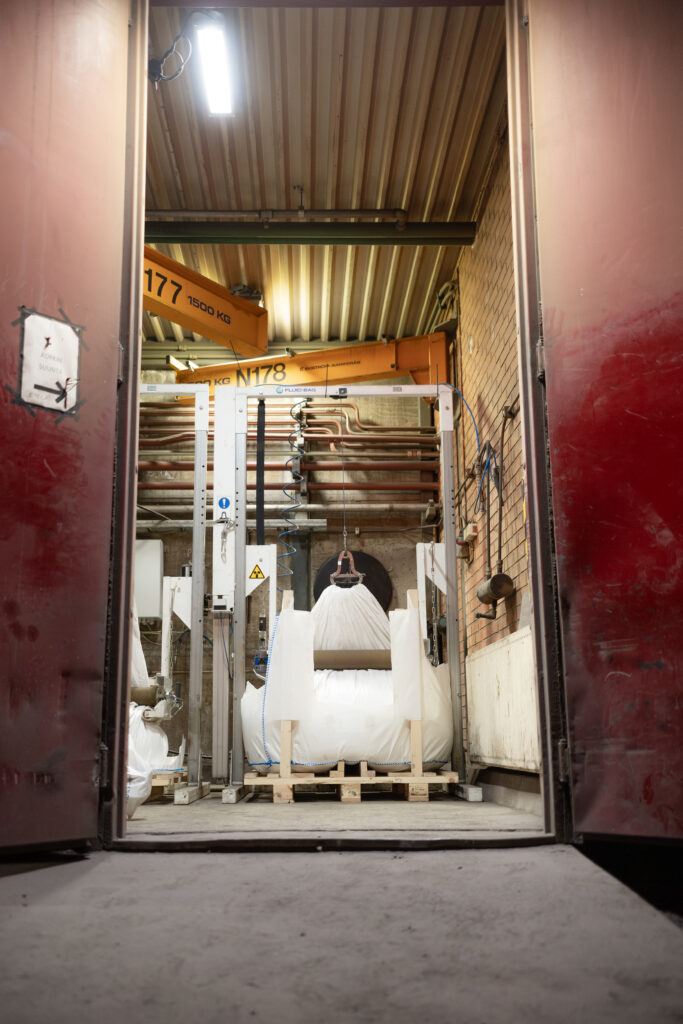
Most maintenance teams in steel mills have never seen a Fluid-Bag. Drums have simply always been there.
In this article, we compare the bulk grease container options, then follow the grease through every step: ordering, filling, transport and storage, connection, bag changes and what happens after the last kilo leaves the bag. We end with the questions to put to your grease supplier and a simple way to size bulk supply to your consumption.
Along the way, we show how SSAB Raahe and Friedr. Lohmann run this setup every day.
Key takeaways
- The steel mill keeps its grease and its supplier. Only the delivery format changes.
- The grease is sealed at the filling station and stays sealed until it enters the lubrication system.
- A Discharge Roller or X-Reel squeezes the bag empty, leaving less than 1% residue.
- One person changes a bag. With two bags side by side, supply never stops.
- An empty bag and a recyclable wooden pallet replace five empty drums.
What is bulk grease supply?
Bulk grease supply means delivering grease to the point of use in containers far larger than the standard 200-liter (55 US gal) drum, typically around 1,000 liters (264 US gal), or in tanker loads to a fixed tank. Steel mills consider it because their centralized lubrication systems consume large, steady volumes, and every container change costs time and adds risk.
That risk sits mainly at refilling.
Grease manufacturers base their shelf life recommendations on grease kept in its original, sealed container, and every opening in the mill exposes the grease to scale, dust and moisture. We explain why that matters in the article Feeding centralized lubrication systems and, for steel mills specifically, in Steel mill lubrication: why heat, dust and water make grease supply a reliability issue.
What bulk grease container options exist?
Steel mills can choose between several supply formats. They differ in how often the grease is exposed, how completely the container empties and what has to happen to the empty container.
|
Format |
Grease opened in the mill? | Emptying | After use |
Typical fit |
|---|---|---|---|---|
| 200-liter (55 US gal) steel drum | Yes, at every drum change | Follower plate and drum pump; grease left on walls and bottom | Empty drum to store, recondition or scrap | Moderate consumption, existing drum pumps |
| Kegs and pails (approx. 18-50 kg) | Yes, at every change | Small pumps or manual; frequent changes | Many small empties | Low consumption, manual greasing |
| Returnable steel tote or grease bin | Connected via pump; refilled by supplier | Depends on tote design | Cleaned and returned; return freight | Regular deliveries from a nearby supplier |
| Bulk tanker to a fixed tank | At tank filling | Pumped from plant’s own tank | Tank must be maintained and kept clean | Very high, steady consumption |
| Sealed flexible IBC (Fluid-Bag) | No, it’s sealed from filling to discharge | Stretched and squeezed; less than 1% residue | One flat bag and a wooden pallet to recycle | Steady consumption, one-way delivery over distance |
For a deeper comparison of drums and flexible IBCs, read Steel drums vs flexible IBCs for grease.
Step 1: How do you order grease in Fluid-Bags?
Switching to sealed bulk supply does not mean switching grease. The steel mill buys the same grease from the same supplier and asks for delivery in Fluid-Bags instead of drums.
Most major grease manufacturers already fill Fluid-Bags. We have worked with the grease industry for decades, including through the industry associations ELGI in Europe, NLGI and ILMA in the US and ALIA in Asia. Greases from NLGI 00 to NLGI III can be handled, which covers the greases typically used in steel mill centralized systems.
Step 2: How is the grease filled at the grease plant?
At the grease plant, a filling station stretches the empty Fluid-Bag to its full length. Stretching positions the top and bottom valves correctly and removes air before filling begins. The grease then flows into a closed bag, protected from airborne particles. Pneumatic filling stations can sit on weigh scales, so each bag is filled to a set weight or volume.
The inner liner (the only part that touches the grease) is new for every delivery. It carries a multi-layer barrier against oxygen and moisture, chosen to match the product. No container is reused, cleaned or reconditioned, so no residue from a previous batch can reach the steel mill’s grease.
Step 3: How are bags transported and stored?
Grease plants and steel mills rarely sit close to each other, so most grease travels one way. The Fluid-Bag rides on a wooden pallet, holding the volume of five 200-liter drums in one unit. At the mill, nothing goes back; no return freight, no drum collection.
Filled bags stack two high and stay sealed during storage. Fewer, larger units also mean fewer forklift movements and less floor space than rows of drums.
Step 4: How is a Fluid-Bag connected to the lube pump?
On site, the bag sits in a discharge machine. For grease, the two main options are:
- X-Reel – A strong, compact machine that winds up the bag with a reel mechanism. It suits all types of liquid and semi-solid products and can be equipped to signal when a bag runs low.
- Discharge Roller – Stretches the bag and rolls the inner liner toward the outlet. The semi-automatic version reduces the need for supervision. SSAB Raahe runs four Discharge Rollers, and Lohmann uses a semi-automatic Discharge Roller.
Read more about the emptying step.
Grease bags use a 3-inch outlet for anything above NLGI 0, with an adaptor between bag and pump. The pump only needs suction, the ability to pull grease from the bag, so the piston pumps common in grease service work well. Depending on the plant, the pump feeds the centralized system directly or transfers grease to the system’s reservoir. Single-line, dual-line and progressive feeder systems downstream stay unchanged.
The discharge machine does the heavy lifting. As the pump draws grease, the machine keeps the bag stretched and squeezed, so grease flows steadily to the outlet with no air exchange during discharge.
Step 5: How is a bag changed?
A bag change is a one-person job. The operator closes the valve, disconnects the empty bag, places a full one in the discharge machine and reconnects. At no point is the grease exposed to the hall.
Many steel mills run two bags side by side, as SSAB Raahe does. One bag feeds the system while the operator changes the other, so the supply never stops. Each 1,000-liter bag at SSAB Raahe lasts about two weeks.
Drums work differently: five changes for every 1,000 liters, each involving a drum weighing around 200 kg (440 lb) full, an open lid, and a pump tube and follower plate moved from one drum to the next.
Step 6: What remains after discharge?
When the bag is empty, less than 1% of the grease stays behind. At Lohmann, the stretching and pressing action brings residual waste below 1%. Rigid drums leave far more on their walls and bottoms, more about that in the article How to get every ounce of grease from your drum.
What remains is a flat, empty bag on a wooden pallet. The bag components, the pallet and the metal parts can be recycled. Nothing needs cleaning, reconditioning or returning; one of the hidden costs we break down in the analysis The total cost of grease drum ownership nobody calculates.
What should you ask your grease supplier?
The grease supplier fills the bags, so the switch starts with a conversation with them. We suggest covering six questions:
- Can you deliver our grease in Fluid-Bags? Most major manufacturers can.
- Which grease grades can you fill, and at what fill weight per bag?
- How is each bag labeled with product, batch and filling date for traceability?
- What lead times and order quantities apply for bulk deliveries?
- How are bags protected during transport to our site?
- Who is our contact if a delivery or bag needs attention?
How do you size bulk supply to your consumption?
Start from the grease consumption of each centralized system. One Fluid-Bag holds around 900 kg (2,000 lb) of grease, depending on density, so annual consumption divided by 900 kg gives the number of bags per year.
From there, three decisions follow:
- Number of discharge stations. Each centralized system with its own reservoir or pump needs its own feed point. SSAB Raahe runs four Discharge Rollers across its systems.
- One or two bags per station. Two bags side by side remove any interruption during bag changes.
- Storage. Stock for a few weeks of consumption, with filled bags stacked two high.
For example, a centralized system that uses about one bag every two weeks – as at SSAB Raahe – needs about 26 bags a year, in place of about 130 drums.
”Nobody in a steel mill wakes up thinking about grease containers. Drums have always been there, so nobody asks why. But ask anyway. Why open the grease five times in the dustiest place in the plant, when it can arrive sealed and stay sealed? The steel mills that asked that question years ago are still glad they did.” – Magnus Berglund, CCO, Squeeze Solution
What does it take to switch?
The change involves three parties – the steel mill, its grease supplier and us – but the process stays simple. We work in five steps:
- Initial conversation. We discuss your centralized systems, greases, consumption and challenges.
- Solution design. Our team and engineers propose a setup based on your grease, logistics and plant environment.
- Collaborative improvements. We present the recommendation and refine it with your team.
- Validation. Where appropriate, we test on site with your grease to confirm performance.
- Implementation. We handle installation, commissioning and training, so your team runs the system confidently from day one.
The steel mill buys the discharge equipment, installation and training directly from us, and keeps buying grease from its supplier as before.
FAQ: Sealed bulk grease supply in steel mills
What is a grease IBC? A grease IBC (intermediate bulk container) holds around 1,000 liters (264 US gal) of grease; the volume of five 200-liter drums. It can be a rigid tote or a flexible container such as a Fluid-Bag.
Can existing grease pumps be used with a Fluid-Bag? In most cases, yes. The pump connects to the bag’s outlet through an adaptor, and the only requirement is that the pump can provide suction.
How much grease is left in a Fluid-Bag compared with a drum? A Fluid-Bag leaves less than 1% residue after the right discharge process. Drums leave grease on the walls and bottom that the follower plate cannot reach.
Do we need to change grease supplier? No. Most major grease manufacturers fill Fluid-Bags. Ask your current supplier for delivery in Fluid-Bags or contact our team of experts.
Do we need to change our centralized lubrication system? No. The bag connects to a suction-capable pump through a discharge machine. The system downstream stays as it is.
How many people does a bag change take? One.
What happens to the empty bag? It folds flat on its pallet. The bag components, wooden pallet and metal parts can be recycled.
One opening, at the right place
Grease reaches a steel mill clean. The question is how many times it gets opened before it reaches the bearings, and where. With drums, the answer is five times per 1,000 liters, in the middle of the mill. With a sealed bulk supply, the only opening happens at the grease plant, under controlled conditions.
Everything else follows from that: fewer changeovers, one-person bag changes, uninterrupted supply, less than 1% residue and no empty drums. SSAB Raahe and Lohmann already work this way, and they show it fits naturally into a steel mill’s existing centralized lubrication.
For the continuous caster in particular, see the article Continuous caster lubrication: why the grease supply matters as much as the grease.
Want to see how it would work in your mill? Book a no-obligation video meeting, and we will go through your systems, greases and consumption together. If it makes sense, we can help with a test, installation and training for your team.
Or explore the solution; fill it, ship it, squeeze it.
This article draws on our work with SSAB Raahe and Friedr. Lohmann and on the sources linked in the text. Written by the Squeeze Solution team.
The courage to [[squeeze through]]
Innovation meets resistance. And since 1984, we’ve been helping companies challenge the status quo and find better ways to handle liquids and semi-solids.
Our solution serve manufacturers and end-users across industries and products: adhesives, sealants, coatings, inks, lubricants, cosmetics, foods, pharmaceuticals, and more.
Maximal squeeze for minimal waste. Let’s pioneer together.
