
WVT, WVTR, MVTR – same measurement, different names
The terms WVT, WVTR (water vapor transmission rate) and MVTR (moisture vapor transmission rate) all describe the same physical quantity: the mass of water vapor that passes through a given area of material in a given time.
The standard unit is g/m²/24h (equivalent to g/m²/day). In the US, g/100 in²/day is also used, roughly 1/15 of the metric value.
A lower WVT rate means a better moisture barrier.
The rate is always condition-dependent. Temperature alone can shift results by approximately 10% per °C, which means a WVTR value without stated test conditions is effectively meaningless. Standard test conditions include 23 °C / 50% RH (73 °F / 50% RH) and 38 °C / 90% RH (100 °F / 90% RH).
How WVT is measured
Three test standards dominate:
- ASTM E96 is the gravimetric ”cup method”. A specimen seals a cup containing either water or desiccant; mass change over time gives the transmission rate. Widely used for films, sheets and building materials.
- ASTM F1249 uses a modulated infrared sensor to measure vapor passing through plastic film. Faster and more precise for thin films than the cup method.
- ISO 2528 is the international gravimetric equivalent to ASTM E96, referenced across European and Asian standards including DIN 53122.
All three produce results in the same unit. The choice of method depends on material type, thickness and required sensitivity.
Typical WVT rates by material
Not all barriers are equal. Published data from Pacific Northwest National Laboratory (PNNL), LyondellBasell and packaging industry references show a wide performance range:
| Material | Typical WVTR (g/m²/24h) | Context |
|---|---|---|
| LDPE film | 16-23 | Common packaging film |
| HDPE film | 4.7-7.8 | Better than LDPE due to higher crystallinity |
| Thick HDPE wall (~2 mm / 0.08 in) | ~0.008-0.02 (calculated) | Approximate for a rigid IBC wall |
| Aluminum barrier foil laminate | 0.001-0.01 | Used in Fluid-Bags and pharma blister packs |
| Steel / glass | ~0 (impermeable) | Moisture enters only through closures and seals |
Note: Values at approximately 25 °C (77 °F). Higher temperatures increase transmission. Test conditions vary across sources.
The difference between HDPE and aluminum is not incremental, it is a factor of 100 to 1,000 per unit area.
Why the WVT rate matters for 1C PUR adhesives
One-component polyurethane adhesives cure through a reaction between free isocyanate (-NCO) groups and water. Water triggers the formation of CO₂ and urea crosslinks, the intended cure mechanism when the adhesive meets wood moisture on a glulam or CLT press.
The problem is that the same reaction happens inside the container if moisture gets in. And the consequences are irreversible:
- Viscosity rise – the adhesive thickens beyond its specification range
- Surface skinning – a cured film forms on top, fouling pumps and dosing equipment
- Shelf life reduction – a product rated for 12 months unopened can degrade in weeks once moisture enters
- Batch rejection – partially cured adhesive cannot be recovered
A US patent on reactive adhesive packaging states that even fractional amounts of water reaching the product surface can render the entire container unusable through skin formation.
The geometry problem – it is not just the rate per m²
The total moisture ingress ”formula” is [WVTR] x [exposed surface area] x [time].
A 1000-liter (264 US gal) rigid HDPE IBC has roughly 6 m² (65 ft²) of wall surface. Even at the relatively low computed rate of ~0.01 g/m²/24h for thick HDPE, that translates to approximately 0.06 g per day across the full container, or roughly 11 grams over six months.
For a moisture-curing adhesive, 11 grams of water can be enough to skin and compromise a significant volume of product. And this calculation assumes a perfect, sealed system.
An aluminum barrier liner at 0.001 g/m²/24h over the same surface area and timeframe admits roughly 1 gram, which is a tenfold reduction before accounting for the additional protection of a closed system that eliminates the air buffer entirely.
What this means for bulk PUR adhesive packaging
The adhesive industry has long recognized that bare HDPE is insufficient for moisture-curing products. Standard mitigations include aluminum barrier foil liners, dry nitrogen blanketing and desiccant, all adding cost and operational steps.
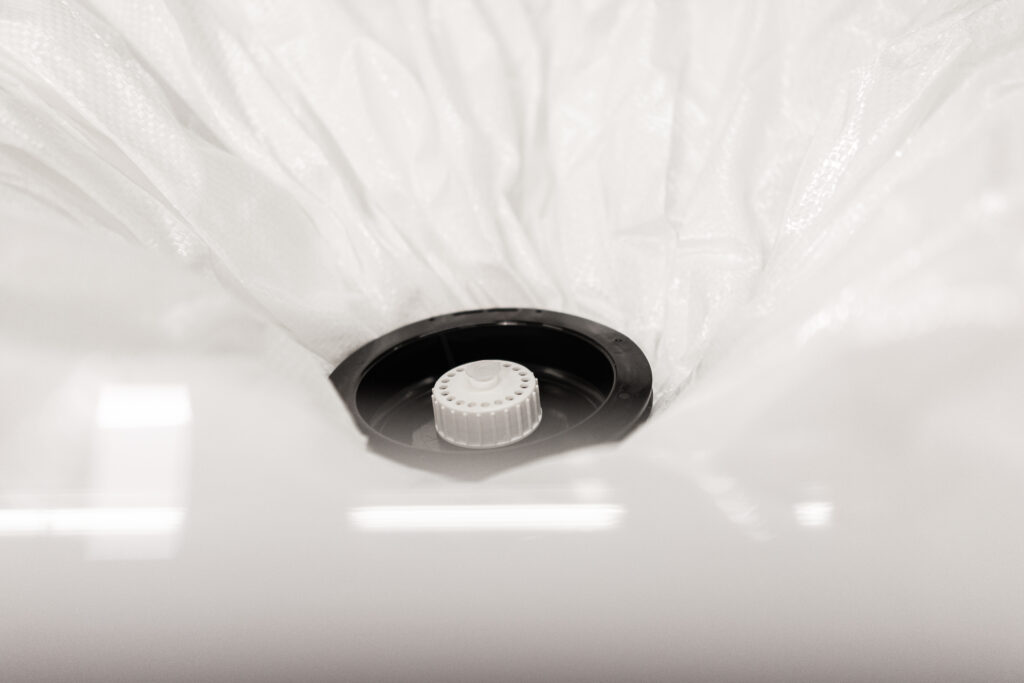
A packaging system that combines an aluminum barrier liner (WVT less than 0.1 g/m²/24h) with a design that collapses around the product during discharge – eliminating both the permeable wall and the air buffer – addresses the problem at the source rather than managing it through workarounds.
This is why the flexible Fluid-Bags with aluminum barrier inner liners have been the standard bulk packaging for 1K PUR adhesives in Europe for decades.
» Click here to see the wood adhesive case study with Kiilto and Hoisko CLT.
