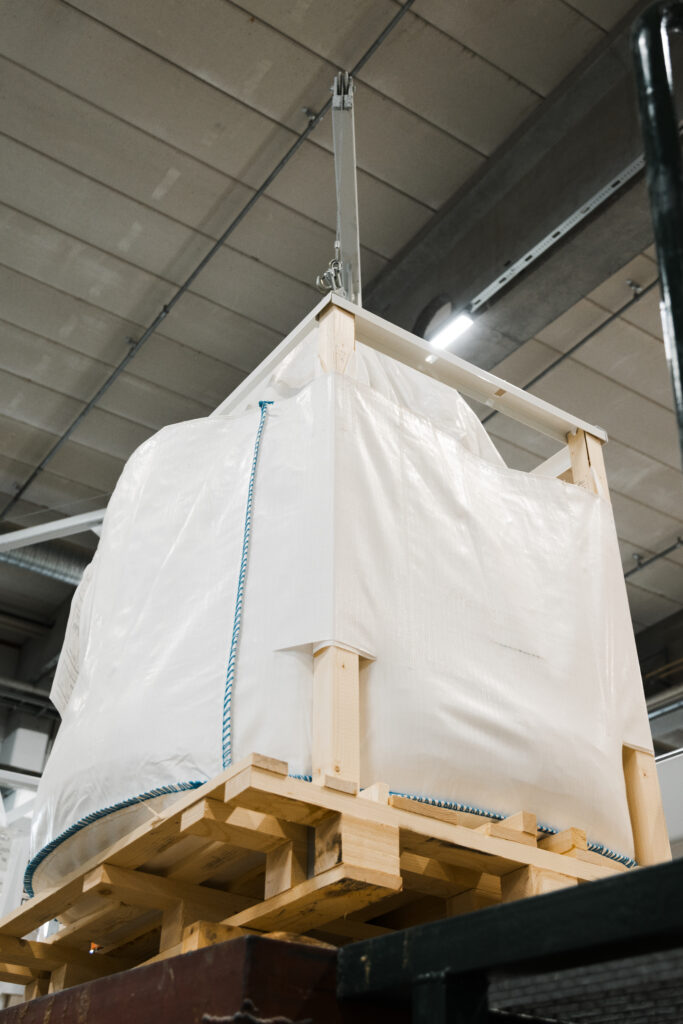
Tahini is valuable, but too much of it never makes it out of the container. The product tends to separate during storage and transport, which can cause various problems. It is often shipped over long distances, sometimes between continents, and by the time it arrives, the oil and solids may have separated. This makes it hard to get the tahini out of large containers. Using smaller containers like buckets makes handling easier, but it also increases packaging and shipping waste and costs.
Most tahini in global bulk trade still moves in 15-20 kg pails, 200-liter drums, or rigid intermediate bulk containers (IBCs). Each format involves its own set of trade-offs. Fortunately, there’s a better way to handle it; from airtight filling to efficient transport to squeezing the last drop out.
How Squeeze Solution works for tahini
Tahini moves efficiently in the Squeeze Solution system; from filling to the last gram at discharge.
Squeeze Solution offers two different options for handling tahini:
- Option 1: The product is mixed directly inside the bag when it arrives at its destination. This is important because tahini naturally sediments during transport. Without mixing, the product will have less oil at the beginning and mostly oil at the end. Squeeze Solution provides a system to mix the product inside the bag.
- Option 2: The product is transferred to a separate mixing tank. In this case, a discharge roller together with a membrane pump is used to discharge the tahini from the bag without mixing it first. The full 1000 liters is moved into a mixing vessel, where it can then be properly mixed.
Squeeze Solution offers complete systems for both options and can also provide tailored solutions to meet specific customer needs.
A key part of the system is the Fluid-Bags, which are food-grade certified and designed for both rotational and single use. The bags are filled and emptied in an airtight way, minimizing the risk of contamination.
» Click here to get in touch with us and explore the options.
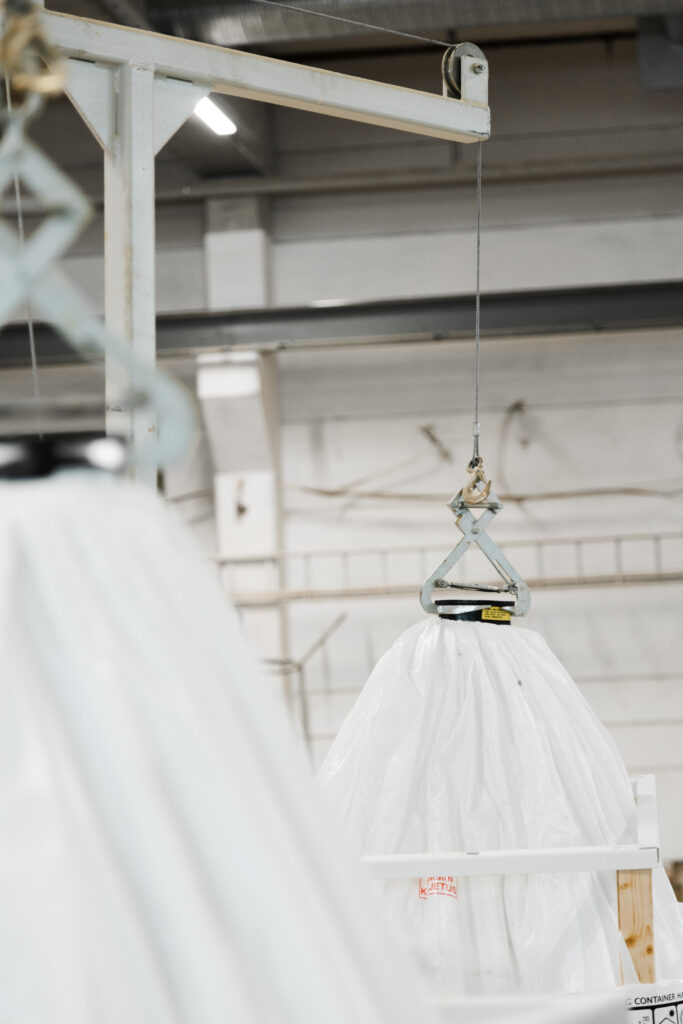
Tahini is a thixotropic material, which means its viscosity drops under mechanical force and recovers at rest. The discharge roller exploits this directly: progressive mechanical pressure lowers the paste’s flow resistance and keeps it moving consistently to the outlet, even after weeks of transit.
Many of our customers reports residual levels can be as low as 1% of bag contents.
» Click here to explore our customer cases from various industries.
Typical set-ups for sea freight or land transport
Two Fluid-Bag sizes are available as bulk packaging for tahini:
- 900 liters (264 US gal) for sea container transport. Dimensioned to fit standard 20-ft and 40-ft shipping containers efficiently, improving utilization grade compared smaller alternatives.
- 1000 liters (237 US gal) for truck and inland transport. Larger capacity per unit for road distribution and cross-border trucking, where shipping dimensions are less restrictive.
Both formats use the same closed-system principle, and the wooden pallet option works as a one-way solution (no return transport needed). After emptying, the components are separated for local recycling.
Recommended Fluid-Bag configuration for tahini
| Squeeze Solution with Fluid-Bags for tahini | |
| Primary use | International sea freight, and/or inland distribution of tahini in bulk. |
| Container type | Fluid-Bag with wooden pallet (one-way transport), or steel pallet (multi-use). |
| Capacity per bag | 900 or 1000 L (237 or 264 US gal) |
| Inner liner | Multi-layer barrier film, food-grade |
| Outlet | 2-inch valve recommended for tahini |
| Filling | Pneumatic filling station on weigh scale. |
| Emptying | Discharge roller or stretching equipment connected to existing or new pump set-up. |
| Logistics model | One-way: No return transport Rotation: Established return routes Internal: From bulk production to filling and packaging lines |
| Certifications | Food-grade; FSSC 22000 (Food Safety System Certification), ISO 9001, ISO 14001, Responsible care, and more. |
Note: The outlet size, pump specification and machine configurations are set based on your product’s exact viscosity profile and storage temperature. We assess this during the consultation to find the best solution possible.
For tahini producers: filling the Fluid-Bag
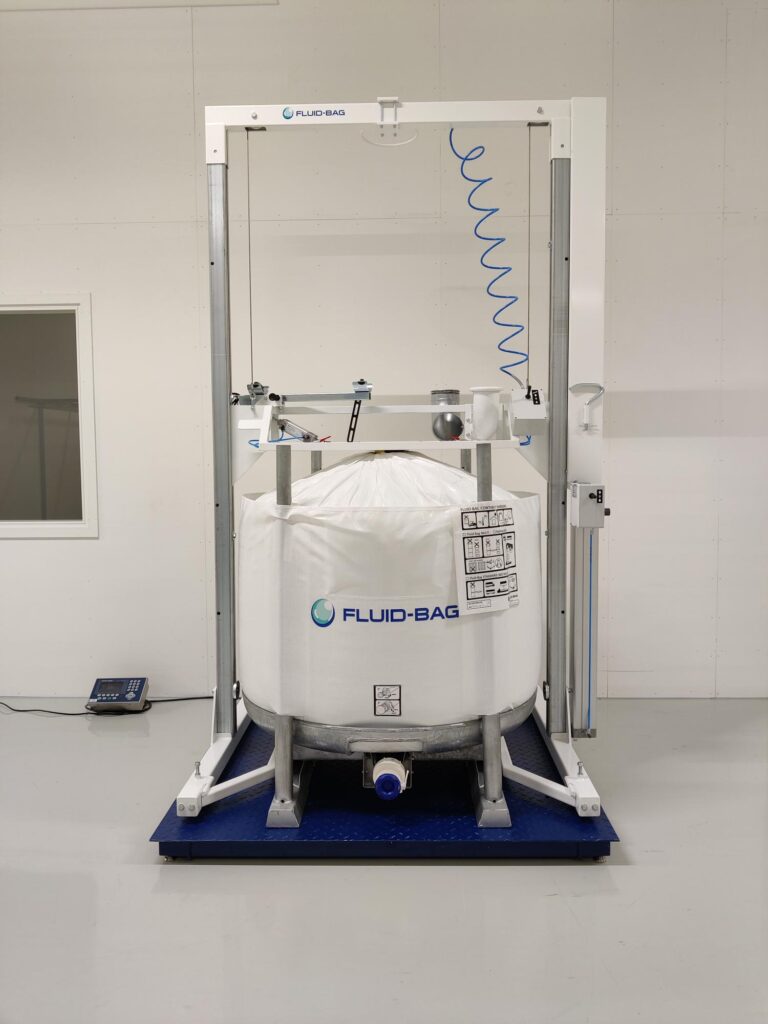
The Squeeze Solution filling process of Fluid-Bags is closed from the moment the bag is stretched to the moment it is sealed; eliminating airborne contamination at the fill step.
The filling station stretches the empty bag to full capacity before filling begins. This maximizes volume, positions the outlet valve correctly and prevents air ingress. Pneumatic filling stations can be placed on weigh scales for precise, repeatable filling weights.
For producers scaling up from manual pail, bucket, drum or IBC filling – the common starting point in Ethiopia, Macedonia, Turkey and other producing regions – the Fluid-Bag system integrates into existing production flows.
Configuration is adapted based on production volume, viscosity and fill-location constraints.
For tahini receivers: efficient discharge of a thixotropic paste
The discharge roller or stretching station pair with a pump recovers near-complete product from every Fluid-Bag; including tahini paste that has firmed or partially separated during transit.
Tahini’s viscosity and characteristics make the emptying equipment crucial. Fortunately, the Fluid-Bag fits all the common pump set-ups, making the transition to those flexible IBCs.
Combined with the discharge roller, which works the Fluid-Bag from top to bottom and exploits tahini’s thixotropic properties to maintain flow, the system feeds directly into mixing tanks without an intermediate open-transfer step.
» Click here to learn more about the emptying process.
Case: International tahini transport – from 20 kg pails to 900-liter Fluid-Bags
A tahini manufacturer in East Africa ships to Middle East. The switch to Fluid-Bags eliminated return transport, reduced manual handling at both ends, and cut residue to below 1% per bag.
The producer manufactures from Humera sesame and exports to a receiver in Israel, where tahini is discharged into mixing tanks and repackaged into retail and foodservice formats including glass jars and 70 kg pails.
Previously, shipments moved in 20 kg pails; intensive manual handling at both ends, significant plastic waste per shipment, measurable product left in each container.
After switching to 900-liter Fluid-Bags, a stretching device ensures precise, hygienic filling at origin. The semi-automatic discharge roller handles the high-viscosity paste at the receiving end, leaving approximately 5 kg residue per 900-liter bag, which translates to below 1% of bag contents.
Additionally, the one-way system eliminates container return transport between countries. All components are separated for local recycling after emptying.
Talk to a tahini bulk-handling specialist
Whether you’re a tahini producer or a bulk receiver, we start with your specific operation and recommend the configuration that fits your needs.
» Click here to book a video meeting or send an e-mail to our experts.